pvc-builder
I need to build a dinosaur for Burning Man. More specifically, a wearable PVC creature with a moving neck, head, jaw, legs, and counterbalanced tail. I built Riglab to check the engineering, then found myself wanting something much faster for drawing the actual creature.
So I built pvc-builder, a 3D-first design studio for SCH 40 PVC. It’s SketchUp if SketchUp knew what an elbow was.
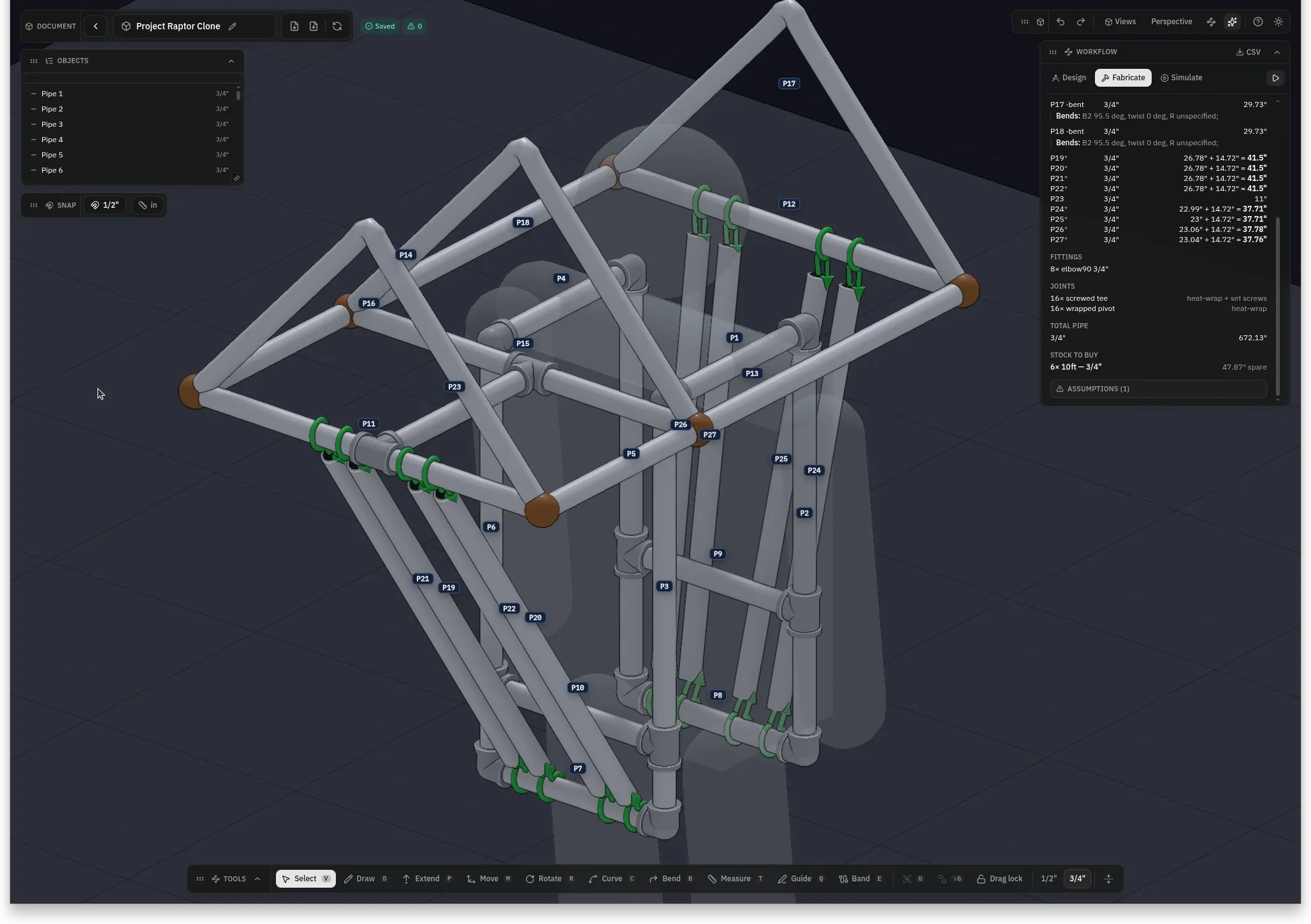
What it does
Draw pipe in a true-scale 3D viewport and pvc-builder infers the fittings as pieces meet: couplings, elbows, tees, crosses, reducers, or a fabricated union when the geometry doesn’t match something from a bin at the hardware store. Straight pipe and heat-formed bends use the same editing tools. Groups, guides, typed lengths and angles, snapping, move and rotate gizmos, copy and paste, and a wireframe mode cover the normal CAD chores.
The editor has three workflows:
- Design: draw, bend, group, measure, and decide how joints move.
- Fabricate: get cut lengths with socket take-offs, bend schedules, fitting counts, CSV export, and the number of 10-foot sticks to buy.
- Simulate: press Play and see the structure hang, swing, and settle on a mannequin under rigid body physics, including pivots and elastic suspension bands.
Everything runs in the browser. There are no accounts and no backend. Projects autosave locally and export as JSON.
The useful weird part
PVC mechanisms don’t stay inside the vocabulary of store-bought fittings for long. The creature frame has heat-wrapped pivots, pipes screwed together at odd angles, and corners I would make by folding one heated length instead of joining two pieces.
The app treats those as fabrication choices instead of generic errors. Its Solve action can turn pipe crossings into rigid unions, convert a nonstandard two-pipe corner into one formed member, and show a fabricated hub where several odd-angle members meet. Those decisions flow through the render, cut list, bend schedule, and simulation instead of becoming a brown mystery blob somebody has to remember to interpret later.
Where it stands
As of July 9, 2026, pvc-builder is at v0.3.13 after 126 commits in a little over two days. It started as a cheaper-model experiment and quickly became a larger project. Opus built the first version and most of the foundation, a Codex pass reorganized the editor and fabrication workflow, and Fable took over for a long interaction and geometry polish pass. I wrote up that coordination experiment in Three coding agents, one workspace.
It still only knows 1/2-inch and 3/4-inch SCH 40, fitting take-offs include documented estimates that need manufacturer tables, and it isn’t a replacement for Riglab’s engineering analysis. That’s the division I want. pvc-builder is where I draw and play; Riglab is where I ask whether the result will fold me into the playa.
Links
- pvc-builder, live
- pvc-builder on GitHub
- Riglab, the engineering counterpart